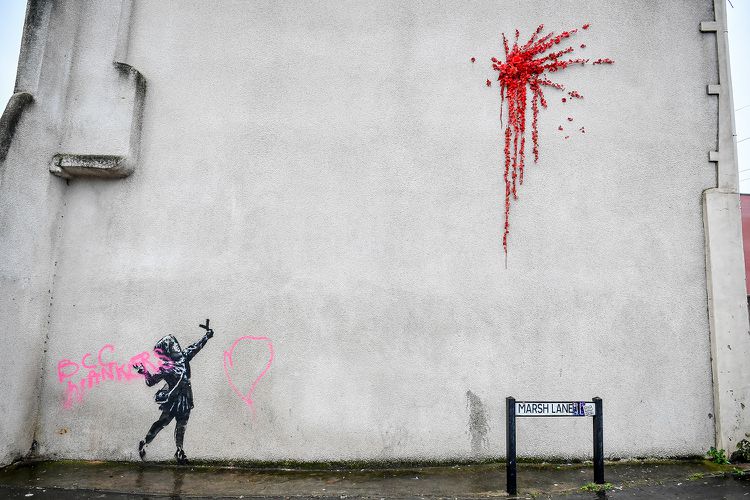
“Mankind, which in Homer’s time was an object of contemplation for the Olympian gods, now is one for itself. Its self-alienation has reached such a degree that it can experience its own destruction as an aesthetic pleasure of the first order.”
The Work of Art in the Age of Mechanical Reproduction
WALTER BENJAMIN
Banksy’s inclusion as the centre piece of the Mutiny in Colour exhibition replete with West Suffolk MP Matt Hancock raving about British culture and art – all the while arresting torturing and fining other less known graffiti artists, only confirm he really is as bland and banal as other manufactured artists featured in the exhibitoin like the Saatchi cultivated Hurst or Emin, raised as exemplars of the great British or indeed English art. All art in this regard is already not military or secret but art-official intelligence. And while some will wanna separate graffiti from street art – vandalism and crime (as destruction) from creativity (creation)( – or politics from art – one good thing is Banksy did at least bring some political consciousness back into street art and thus at least attempts to lay this bare.
Whats most redundant tho in Banksy’s work is the reliance not on stencils, as some banal purists whine, but on photography as a representational form. In that the stencils always use photography as well as painting to create their images and appear as iconic. Walter Benjamin already made this critique in a roundabout way in “Art in the Age of Mechanical Reproduction” as well as in his 1931 essay A Little History of Photography :
“[Photography] has become more and more subtle, more and more modern, and the result is that it is now incapable of photographing a tenement or a rubbish heap without transfiguring it. Not to mention a river dam or electric cable factory: in front of these, photography can now only say, “How beautiful!””
He didn’t know that Mussolinis use of stencil art to propogate for fascism in Italy would inspire Blek Le Rat who in turn wqould inspire Banksy – or couch his critique in terms of Piercian semiotics so I will spell it out here. The limitation of photography is not just that it can only speak of how beautiful the object is, ie aesthetics but that it is limited to the iconic. Iconic in the sense of piercian semiotics: the icon, as opposed to the index and the symbol, is a spacial representation of what is signified. Often drained of any life and reduced to a black shadow form, the forms are 2 dimensionalised and flattened. A photo of a banana signifies a banana, a bazooka a bazooka, a picture of a pipe is just a pipe. Where banksy uses text it is usually illustrative rather than metagraphic as in memes. Meaning is in the iconic image – often life size figures in the street. As we see these flattened representations we are ourselves flattened into the spectacle they create. All artists just shit in your head.,’
In this sad cultural climate it has been good to see painters pushing boundaries of both art and political dissent and action with the re-emergance of red action paint in protest – especially around Gaza and Palestine this year. While Just Stop Oil have used orange as a colour to carry out their actions – painting over famous art works or cultural monuments like stonehenge it is the use of the colour red that brings the Palestine Actions works to a more focussed and concentrated purism.
The use of red paint in protest and art goes back a long way – especially in London. Two examples are the Gladstone statue in Bow and the fountains at Trafalgar Square.

The Gladstone statue is a statue of the MP who brutally suppressed local factory workers and charged them to erect his statue. In Bow regularly and consistently has its extended hand painted red. The red thus appears as a spot – a single dot. Even though it is in fact a plane – approaching a circle filled in in the palm of the hand of the statue. Here there is no p[rotest as in there is no demands being made of power explicitly. The dot has no dimensions at all – even less than the 2 dimensional icons of banksy, this dot only has meaning because of the statue and the placement in gladstones hand. Red paint in the fountains at traf square also begin as just a dot – before spreading across the three dimensional volume of water – appearing to us on the two dimensional surface. Seen from a distance it can return to appearing as a dot. Without any textual information we cannot discern the meaning of the painting. We also note here that there is no one taking accountability or credit here. No artist, celebrity or otherwise. There is no one making capital here. Not even an organisation, political or otherwise. In fact it is only through the local proletarian consciousness, through folklore and urban myth, that we know this and thus the meaning is delivered. –
Thus we see red paint being used systematically and in an organised manner by left wing critical groups and by proletarians ie members of the working class who are communicating through a political consciousness that establishes them as such in dialogue with us as the viewer – we could say it is art that is protest or a protest thats art – but it is different from protest art. Here the situation or context – the site of the painting, the identity or non identity of the painter, the metagraphy, is vital.
While banksy illustrates a fantastical image in 2 dimensions on the london zoo – an iconic fantasy that serves really as advertising in its artful illustration. As his supposedly anti advertising politic is now as a million pound fetching artist his street work is just advertising for his prints and gallery work, the absesne of not just the canvas or the easel – but the art gallery art dealer curator or critic – actions of redactionist painters really goes outside the art system and political system.
Banksys reliance on representational icons renders his critiques limited precisely because of the attempt to create meaning. As Debord and Wolman note in Theory of Detournment: the weakest metagraphy is when the detourned image and text relation simply reverses the intended meaning of the original. The london zoo painting shows this weakness in practice.
The JSO or Pal Action paintings – precisely because of the lack of dimensions – a simple dot or splatter – sometimes verring into lines streaked across the surface of this institution being critiqued – pushes the impetus back onto the institution itself rather than in the painting. It is the anti-significational quality of the dot – as of ocurse the Nuqtaviya (Dottists), who succeeded the Hurufis (Lettrists) well understood. But to return to JSO or PalAction – these groups do however then rely on a statement or performance of reading a statement – a textual element to the situgraphy that is reproduced in mass media via other spectacular apparatus for the production or construction of meaning. Of course these can be collapsed by redimensionalising – adding the dimension of symbolic as well as indexical metagraphies really become situgraphies with he combination of iconic representations also with symbolic ones – language and text. But also the indexical. It is here that site specific paintings – on institutions that the building or site itself is transformed into an index that forms part of the painting just as the canvas does in conventional bourgeois painting.
We can see this with red slogans being used in street art/ painting. The Chinese Communist Party takebao/ dakebao letters in brick lane recently reversed this – the site being a common one for street art in London was adorned with huge red takebao letters – symbolic signs representing the slogans of the CCP. This politicising of art doesn’t realise Benjamins idea. The brick lane bridge has political as well as aesthetical graff and street art mixing. Both iconic images, text (tags, slogans, sentences, even passages – sometimes even just letters like the takebao) but hardly ever indexical signs. A contrasting example is the Janes Revenge painting slogans on anti-abortion propganda cenmtres in the USA red was not the only colour but initally it was the red slogans that kick started the movement and worked very effectively. The obvious connotation is blood but also socialism.
Lets contrast this to Ukrainian artist Alex Mashtalers slogan ARTEM WAR CAN KILL YOU on the ARTEM factory wall in Ukraine. The whole factory is transformed into an index. Just like banksys london zoo action where the zoo becomes the indexical sign,. So where banksy has a 2 dimensional iconic sign with the zoo as indexical sig, Alex uses a sentence ie a 2 dimensional construction of symbolic signs and the arms factory as indexical sign. In both cases the indexical sign is apparently a 2 dimensional wall/ surface, it is what is going on behind the wall that counts. so now the situation must involve a look at who the painter is not just where – a Ukrainian painter painting on a Ukrainian weapons factory in the city is different from an English artist painting on a zoo. Even with Banksys other animals painted around London the effect is just advertising – either for Banksys art or even for London zoo. Does the Kiev graffiti advertise the weapons factory? The answer of course is that to certain people it does. There is no such thing as bad publicitiy – but the arms manufacturers, like Elbit Systems will spend money on removing the paint instead of preserving it. This in order to consider painting as a situation rather than just a spectacle we need to also consider the temporal dimensions of its effect. The painting will be changed over time – ie erased by Elbit. The fact that this defensive action – making this into an act of anti-advertising – marks the temporal limit of the painting is essentially what makes it into another dimension of time ie the magnitude of the action.
Anopther dimension that should be mentioned is the identity of the artist – in Banksys case he is shielded from prosecution and allowed by the Police and British state to extract the proceeds of his crimes unmolested by them. Activists of Palestine Action however are not afforded and neither do they claim such a luxury. Banksy here has been given an elevated status – pulled out of the mass of the working class. sure he is very middle class private school educated white boy but no one can doubt that he has put in the work and deserves respect for that – but now he has been protected by the state and elevated to godlike status of a capitalist. The artist in this way is the perfect capitalist.
Labour alienation and land alienation are both necessary for the maintenance of the spectacle or cultural capital that acts as a surface to mask social relations. The spectacle therefore always conceals around the reality of capitalist relations by adding an image of utopia on top. The image which regulates relationships towards capitalist subordination. Religious or indeed art performance of transubstabtiation – the transformation of bread and wine into the body and blood of Christ also works the other way round. Ie as the bread or wine passes the lips of the faithful it becomes the body and blood of Christ- a sympathetic majik where body of the faithful becomes body of Christ ie only through the bodily process does the spectacle become real and the change to capital occur
the power oif the image – the spectacle – as Samir Al -Khalil wrote about Sadaam Hussain use of monuments totalitarian image – in 1991. toppling of statue became an iconoclastic TV image/ moment a little over a decade later. In this was the statue is what is in semiotics terms an icon – demands identification with. Like Christ – the whiteman – to become or to be God – this is the goal of capitalist and capital – and the spectacle. all the revolutionary heroes are bound in this logic – Marx himself encompassed by the Judeo Christian epoch too, the last profit… only saw production – never reproduction nor destruction – except as a fetish – ie held as a symbol in commodity (productive) form (eg his treatment of Helene Demuth)
the symbol – or we should say sign in its 3 forms shows the journey from labour to capital ie from human to god – icon, index and symbol. the whiteness of skin is the icon but only held in place by performed sovereignty. for example the white woman becomes god not through some abstract mechanism but through the through “real” “people”: Thatcher, through Elizabeast II, that is the icon of white supremacy.- and the actionist too through their artists. the mechanism is the same and the effect too
Statues as icons and idols, and the movement of smashing them, is a good example of the revolutionary iconoclasm of creative destruction of the proletarian and decolonial art. The toppling of the Coulston statue, following its covering in graffiti and replacement by the hundreds of placards and slogans – these canvases and self published micro manifestos – is a form of collective creativity to be defended. Let’s note: here too that it was Marc Quinn, one of the yBa who was in a position to very quickly design and create a statue of one of the protestors and replace the Colston statue on the now empty plinth. That Quinn is white and the protestor black is also significant. Because the original ground – of Bristol Council – i.e. the British state has a particular relationship with that statue of the white slaver and profiteering capitalist. And so does Quinn, a white Franco-British artist. And the protestor is definitely excluded from that identity, that organisation, that representation and therefore subject to it. Her black presence here can very easily becomes a fetish/meme that creates capital for the whiteness that produces it here.
However, as the model Jen Reid makes clear, there is here another identity that is historical consciousness of black liberation. The moment that is captured is from a spontaneous action by Jen Reid in climbing the empty pedestal. This was documented in a Polaroid picture taken at three time and then recreated by Quinn. The fact that the proceeds from the sale of the statue will be going to black projects and charities is a crucial shift in ownership. That the charities are also both initiatives that promote and support educational projects and curriculum development of black history is also crucial. The spectacle here is entered into and literally overturned! And a new situation has been created. http://marcquinn.com/studio/news/a-joint-statement-from-marc-quinn-and-jen-reid
the tension here is between Reid as a working class proletarian and Quinn as a bourgeois artist – sometimes theirs artwork can be seen as revolutionary self actualising of black people as a revolutionary class effecting society for a move towards classlessness and the abolition of private property. Sometimes an art piec of neoliberal capital especially where credited to Quin, one of the products of Saatchi young British artist movement
the difference between maintaining and developing spectacle and the construction of situations is about the difference between capital and labour – the concrete production of alienation is what the spectacle involves but just as every commodity is based on use value it is based on labour, so every spectacle has within it the construction of a situation that can be overturned by bringing use value back, by dissalienation. recently the decolonise movement works in the same way. that is if we see colonialism as capitalism – ie the colony is the commodity – land alienation prefigures the alientaion of labour. this is the sense that psychogeography is a revolutionary – and why andrea gibbons correctly identified the fall of the Algerian section of the international as the crucial turning point of situationist theory away from psychogeography and towards that of the spectacle.
what the Actionists, like the situationists could not overcome was their own nationalist prejudices that revolved around white supremacy – because it revolved around themselves. coming back again and again to western Europe – even the final fugitives of voina escaped to western germany and others moved through Israel, the failure is engendered in the the disparity between the arab spring and the occupy movements. the same psychogeographic of overturning central town and city urban design by invading city squares – from every continent since 2000, the general or citizens assembly could not contain the democratic and anarchic force of the movements. and this is because they could not contain or express collective identity/ identities with enough accuracy to provide a decision making process that was robust enough for the people involved to be able to take decisive and intersectional action in situ
In 2018, saatchi sponsored an exhibition called Riot art: post soviet actionim which toured western europe – curated by Masha “from Pussy Riot” among others from the interventionist and post situationist actionist art scenes across central and eastern Europe and Russia. Its worth noting that masha (and Nadya) had by now, been been formally excluded by the original Pussy Riot group due to the playing of ticketed performances (eg with Madonna) and contravening the women only rule in the band/group by stating “anyone can be pussy riot” (also with Madonna) https://www.theguardian.com/music/2014/feb/06/pussy-riot-madonna-amnesty-concert
the history of what Saatchi – and others, including some artists from the scene – refers to as Actionism, n a performance art tradition, also has other roots and currents around it. Most of those involved don’t use the term Actionism, even in Moscow. And the interventionist guerilla performance practice that is characterised by Saatchi’s construction is no way limited or centred on Moscow or the post soviet region, whether historically or geographically. The avant-garde techniques involved most obviously date to Dada but if we really take a de-colonial feminist and working class perspective then we see these actions and activities as a common aspect of working class life in our resistance to bourgeois cultural capital all over the world. Worth noting that these methods are not limited to art or activism but also encompass spiritual and religious cultural contexts as well as, most importantly, everyday life.
We can look at the difference her between Brett Baileys art show at the Barbican in London in 2015 where he paid black performers to pose as slaves as objects of the white gaze in rooms arranged by bailey. There was a lot of reaction to this and the show was shut down by a creative interventions by black and brown and other activists and artists. The demonstration which involved African drumming and chanting was what finally lead the Barbican to withdraw and shut down the show. These methods are not (just) art ones but in African traditions have deeper and more widespread meaning and function for the formation of community. In contrast, but at roughly the same time, Crazinist Artist Wa Biene did a performance called Return of the Slaves – where many black performers entered the role of slave. He also gained criticism but it is worth noting how different this performance was. Instead of a gallery in London this was enacted at a port in Ghana where historically people were kept before being shipped and sold as commodities. We therefore see this as a very powerful situation constructed to re-empower and concentrate the participants as well as observers.
Wa Thiong’o, in outlining the decolonisational force of African theatre – in its situated location in the village, in traditional language and the division of labour, is an example where intersectional organising not just in intersections of oppression but of national identity and power – shows a Marxist theatrical form that corresponds more to Boal’s theatre of the oppressed (invisible, Forum theatres) or Lorca’s La Baraca. But these also did not see through the logic of nation and language. To theatre of oppressed let’s add the pedagogy of the oppressed – in the considerations of language in a relationship where student and teacher is truly equal the only expression can be asemic language. This is not just the community of revolutionaries as envisaged by Black Mask. We should here mention digital blackface or rather spectacular blackness like Luther Blissett in Italy – its no surprise that the white Italians even started a prank with a painting monkey called Loota or that the biggest right wing psychic workers militia Q Anon was inspired by them. Black Mask on the other hand did not confuse themselves with their black nationalist comrades but rejected whiteness as an act of solidarity. However they also could not go far enough to create the internationalism required – and partyl this was another failure of the avant-garde of the time.
The cause of the failure is that within Europe, politically there are different sides to the avant-garde, fascists, neo/liberals, anarchists, communists. So just as the classical avant-garde had fascists of Italian futurism, Bolsheviks of Russian futurism and German constructivism, anarchists and communists of Dada and the neoliberals of the Bauhaus so did the 60s performance art scene with Gustav Metzger going on art strike at the same time that Joseph Beuys was cosying up to fascists in the green party and so also does the contemporary movement span the political spectrum. Saatchi’s riot art Actionism purposefully blurs the political boundaries between neoliberal Belarusian art theatre or Masha and Nadya with the radical anarcho feminism of pussy riot or the national Bolshevism of some of those involved in Voina and the outright anarchism and post situationists pranksters including Neoists. Voina notoriously had Nazbol fascists leading to a departure of the feminist anarchists who went on to create Pussy Riot.
Finally lets consider how Banksy rose to fame with images of war – ambiguoius images due to the lack of clarity and political directiopn supposedly. But is that really the case? It was during the War on Terror that Banksy rose to fame – showing police wearing smileys and war planes with pretty bows on. Ironic? I would suggest not. His recuperation of subverive art was evidently a chearleading of the so-called ar on terror, the invasion of Iraq, the atrocities of Guantanamo Bay and etc by NATO during this period. And he has been richly rewarded for it.

Cambridge Lettrist And Situationist Society
2025